The fibre
Does silk absorb less moisture than cotton? The 11% figure explained
You will often read that silk absorbs less moisture than cotton. On moisture from the air, the standard textile figures say otherwise: silk holds as much as cotton, or a little more. The number behind that is 11%, and it helps to know what it measures and what it does not.
What does moisture regain mean?
Moisture regain is how much water vapour a fibre holds from the air, as a share of its dry weight. It is measured in standard conditions, 21°C and 65% humidity, so fibres can be compared fairly. It is about vapour taken up from the air around the fibre, not water poured onto it.
Here are the standard figures, as a share of dry weight:
- Wool: 13 to 18%
- Silk: about 11%
- Cotton: 7 to 11%
- Nylon: 4.0 to 4.5%
- Polyester: 0.4 to 0.8%
They come from Coats, the thread maker, in its guide to textile fibres. The same figures appear in Kadolph's textbook, Textiles. The moisture section of our science page shows them as a chart.
Does silk absorb less moisture than cotton?
Not on this measure. Silk sits at about 11%. Cotton sits between 7 and 11%. So silk holds as much moisture from the air as cotton, or a little more. The common claim has it the wrong way round.
You may also see tables that put silk at 11% and cotton at 8.5%. Those figures are commonly quoted from ASTM D1909, a standard that sets agreed commercial values for trading fibre. ASTM itself says they are trade figures, not measured ones. Read either way, silk is not the lower of the two.
Wool is the one fibre in the list that clearly holds more than silk. Polyester holds very little.
Does cotton soak up sweat faster than silk?
This may be where the claim comes from, and the evidence is thin. A small physiology study at Nagasaki University put patches of cotton, silk and nylon over sweating skin. The amount of sweat did not differ between them. What differed was how much each fabric slowed changes in humidity and evaporation: cotton most, then silk, then nylon, in line with how long each took to dry.
TRI Princeton, an independent lab that tests hair and textiles, cites this study for the idea that cotton absorbs more water than silk. It is one small, older study, on clothing patches. It did not test pillowcases, and it tells us nothing about your face or your hair.
So the honest answer has two parts. From the air, silk holds as much moisture as cotton or a little more. For liquid sweat, one small older study suggests cotton takes it up faster.
How does silk compare with polyester satin?
This is the clearest gap in the table. Silk takes up about 11% of its weight in moisture from the air. Polyester takes up 0.4 to 0.8%, which is under 1%. Most low-cost satin pillowcases are polyester, so if you are choosing between silk and satin, this is a real, measured difference between the two fibres.
They are different materials. Silk is a natural protein fibre, made mostly of fibroin. Polyester is made from fossil fuels. Both can be woven with a smooth satin face. The moisture figure is one simple way to see they are not the same thing.
We compare the two in full in silk vs satin pillowcases: what is the difference?
Will a silk pillowcase leave more night cream on your face?
No study has shown that. We found no independent test of how much face cream a silk pillowcase takes up. One brand says its pillowcases absorb significantly less face cream than cotton, from an unnamed lab, with no figures or method published. We don't repeat claims we can't check.
Skin hydration is the same story. We found no study measuring hydration or water loss from the skin of people sleeping on silk. A trial of mulberry silk against cotton pillowcases was registered in 2023, and water loss from the face was one of the things it planned to measure. It has not reported any results.
So the 11% figure describes the fibre. It is not a promise about your skin, and we won't tell you silk keeps your face hydrated or keeps your skincare where you put it. Our science page lists these with the other claims we don't make.
What does this mean when you choose a pillowcase?
Choose silk for what it is: a natural protein fibre that is light and smooth, and that holds far more moisture from the air than polyester satin. Don't choose it because someone told you it absorbs less than cotton. On the standard figures, it doesn't.
Whatever your pillowcase is made of, wash it every week. For silk, use cool water and a pH-neutral detergent with no enzymes or bleach, skip the tumble dryer, and dry it out of direct sun, which fades silk over time. Our care guide has the details.
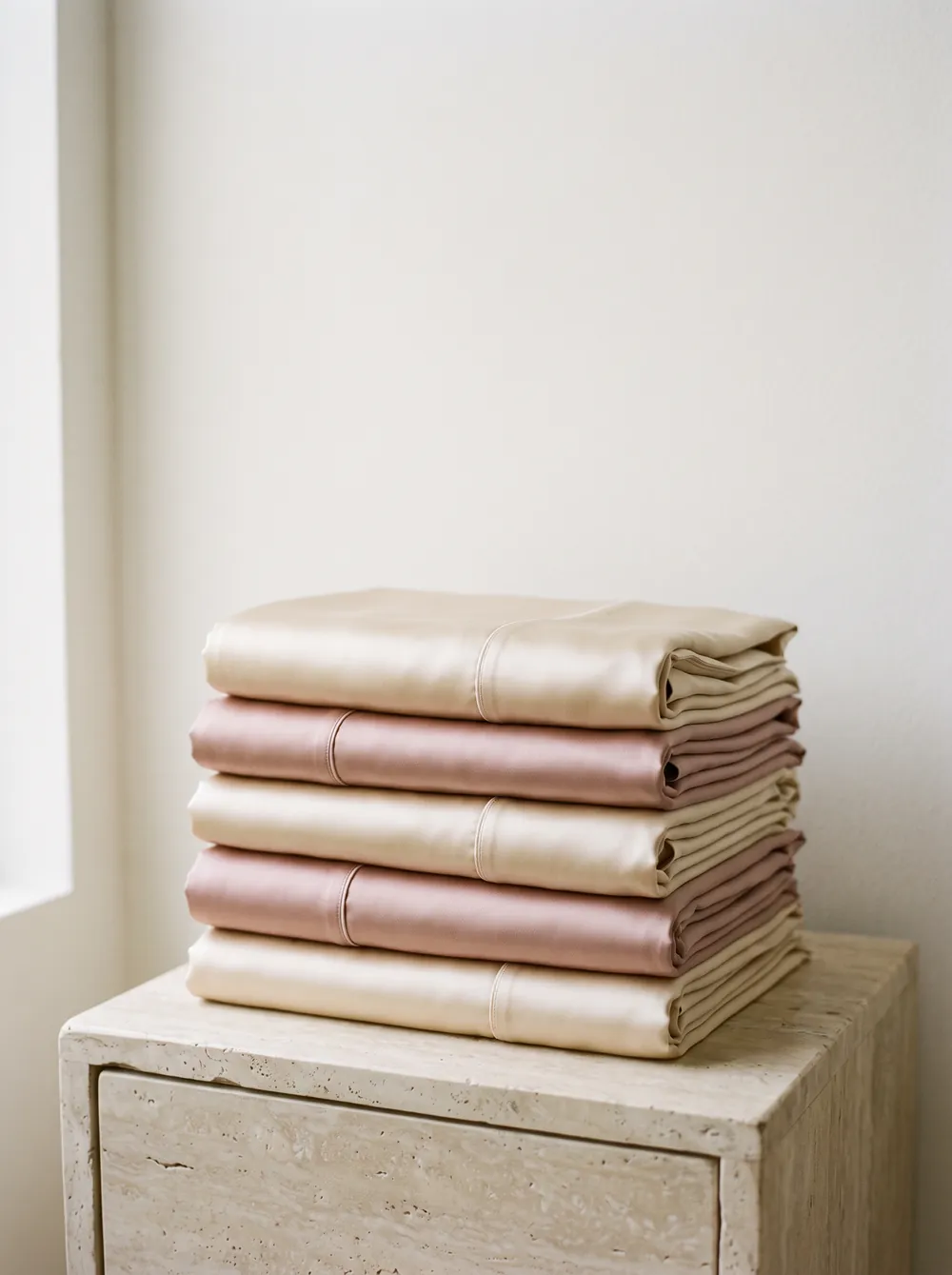
SOIEA is 100% mulberry silk at 22 momme, in champagne and blush, launching in December 2026 for the UK and Ireland. See the pillowcase.
Questions people ask
How much water vapour a fibre holds from the air, as a share of its dry weight, measured at 21°C and 65% humidity. Silk is about 11%, cotton 7 to 11% and polyester 0.4 to 0.8%.
We don't use the word. It is contested, and specialists writing on fabrics for eczema say woven silk can reduce transpiration. What we can say is that silk is a light, smooth, natural fibre.
No study has shown that. We found no study measuring skin hydration or water loss on people sleeping on silk. A trial registered in 2023 planned to measure water loss from the face, and it has not reported.
That figure is commonly quoted from ASTM D1909, which sets agreed commercial values for trading fibre, with silk at 11%. ASTM says these are trade figures, not measured ones. On them, silk still holds more than cotton.
Sources
- Coats, Know about textile fibres
- ASTM D1909, Standard Tables of Commercial Moisture Regains and Commercial Allowances for Textile Fibers
- Kosaka M, Ohwatari N, Matsumoto T, Otomasu K, Yamauchi M. Analysis of sweating through clothing materials due to ventilated sweat capsule method. Descente Sports Science Vol. 15
- TRI Princeton, Everyone is talking about silk pillowcases
- Integrative Skin Science and Research, Assessment of the effects of silk pillowcases on acne prone skin, ClinicalTrials.gov NCT06142487
- Aad R, Dragojlov I, Vesentini S. Sericin protein: structure, properties, and applications. J Funct Biomater, 2024
- Ohio State University extension, Silk fabric care fact sheet
Every claim here is checked against the published sources above and our graded evidence page. We don't make claims the evidence doesn't support.
Keep reading
The fibre
Silk vs satin pillowcases: what is the difference?
Satin is a weave, not a fibre. It can be woven from silk, but most low-cost satin pillowcases are polyester. Both are smooth, and dermatology guidance for curly hair says satin or silk, not one over the other. The clearest measured difference is moisture: silk takes up about 11% of its weight from the air, polyester under 1%.
· 4 min read

Hair
Do silk pillowcases help curly hair? What dermatologists actually say
UK and US dermatology guidance for curly and Afro-textured hair suggests sleeping on silk or satin to cut overnight friction, and the AAD adds it may help preserve your style. That is expert advice, not a trial result. No study has tested a silk pillowcase on hair, and the guidance names satin and silk equally.
· 4 min read
Buying guide
What does momme mean? 19, 22 and 25 momme explained
Momme is a weight. One momme is 4.34 grams per square metre, so 19 momme silk is about 82.5 g/m², 22 momme about 95.5 g/m² and 25 momme about 108.5 g/m². A higher momme means more silk and a denser, heavier fabric. It is not a grade of quality.
· 3 min read
Be first to sleep on it.
22 momme mulberry silk, launching December 2026. Shipping to the UK and Ireland.
Join the pre-order list